Toronto Wedding Photography: The Complete 2026 Guide
If you are planning a wedding in Toronto, photography is one of the few decisions that will outlast the day itself. The flowers wilt, the food is eaten, the dance floor empties — but the photographs are what your family will hold in their hands twenty years from now. They are also what your future kids will scroll through on a phone, what gets reprinted on a fortieth-anniversary slideshow, and what defines how the day is remembered long after the memories themselves have softened.
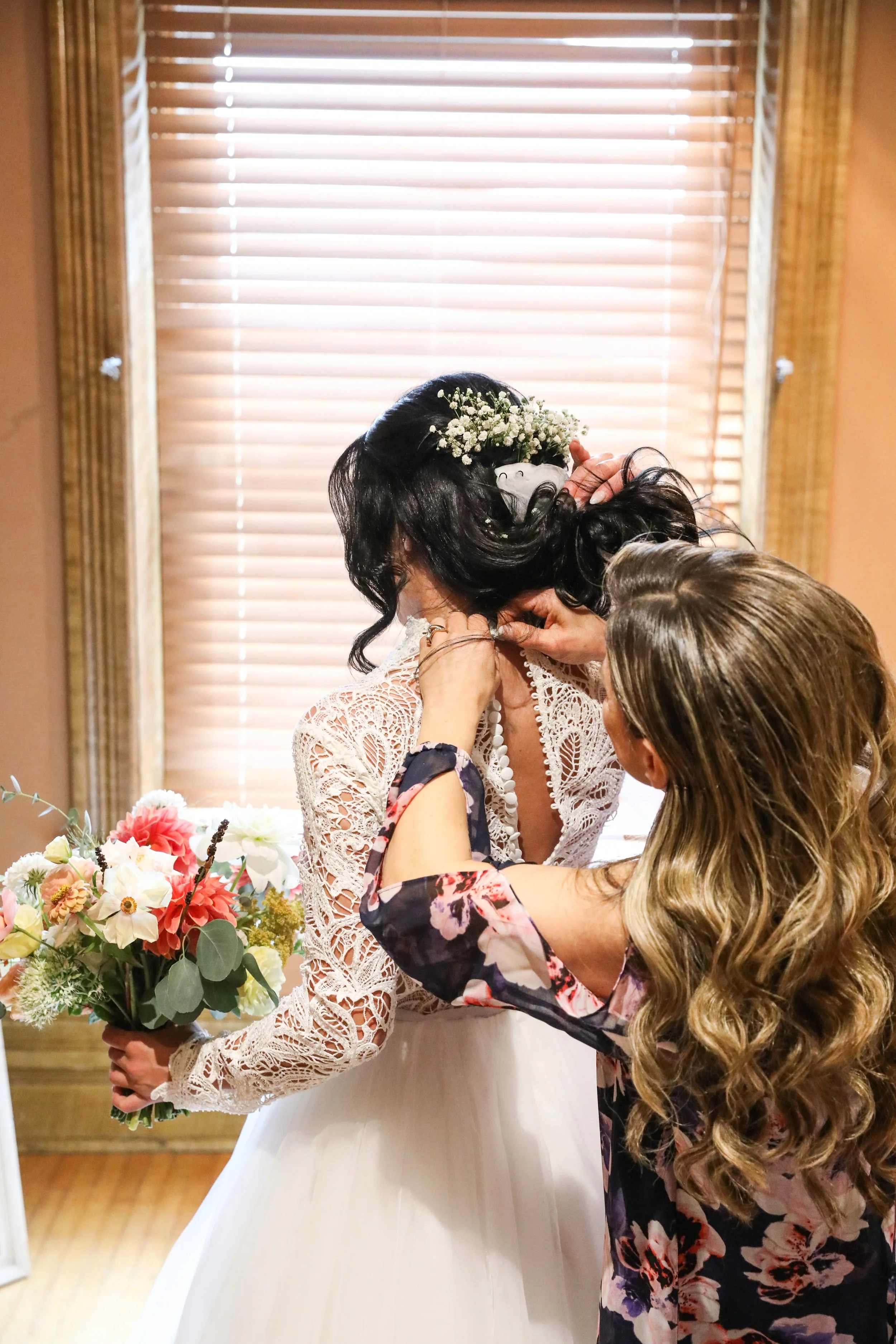
Back view of a bride getting ready as her mom helps adjust her dress.
That is a lot of weight on one decision, and Toronto does not make it easy. The city has hundreds of wedding photographers across every price point, every style, and every level of experience. Some are studios with decades of brand recognition, some are solo artists with a distinctive voice, some are talented hobbyists charging professional rates, and some are people who bought a camera last spring. Telling them apart from a website is genuinely difficult.
This guide is designed to walk you through the entire decision: what styles exist in the Toronto market, what they actually cost in 2026, how to read a portfolio properly, what timelines look like for a typical GTA wedding day, and what questions to ask before signing a contract. It is written by Tomas Makacek, owner of Makacek Studios, with nine years of photographing real Toronto weddings as the foundation. The goal is not to sell you on any one photographer — it is to give you the information you need to choose well, even if that choice ends up being someone else.
The Three Photography Styles That Dominate Toronto Weddings
Almost every Toronto wedding photographer falls into one of three broad style buckets. Understanding which one you actually want — not which one sounds best on a website — is the single most important filtering decision you can make.
Documentary / Photojournalistic
Documentary photography is the style we shoot at Makacek Studios, and it is also the style most often misunderstood by couples. The photographer's job is to disappear into the day and capture what is actually happening — the genuine laugh between your dad and your maid of honour, the look on your partner's face when you walk down the aisle, the chaos of getting ready, the unguarded moment after the ceremony when nobody is performing for the camera anymore.
What documentary photography is not: it is not "we just stand around and hope something interesting happens." A skilled documentary photographer is constantly anticipating, repositioning, and managing light. They know to stand at the back of the room during your first dance because the silhouette against the spotlight will be the photo you frame. They know that the genuine reaction to a speech happens three seconds after the punchline, not during it.
This style ages well. Trends in editing and posing date quickly — a heavily posed 2014 wedding looks like a 2014 wedding. A documentary photo of your grandmother crying during your vows looks the same in 2050 as it does today.
Editorial / Fine Art
Editorial wedding photography prioritizes magazine-quality composition, intentional posing, and a polished aesthetic. The photographer directs more of the day, designs flat-lays of your invitation suite and rings, and treats the wedding partly as a styled shoot.
This style works beautifully for couples who love planning, who curated every detail of their day, and who want imagery that could appear in a Toronto wedding publication. The trade-off is that it requires more time carved out of your timeline for portraits, and the photos can sometimes feel staged in retrospect.
Hybrid Candid + Posed
Most working Toronto photographers actually shoot some version of a hybrid — mostly candid coverage of the day, with a structured 30-to-45-minute portrait window for couple photos and family formals. This is the format most couples assume they are getting when they hire any wedding photographer.
The differences between hybrid photographers come down to which side of the hybrid they lean toward. Some are 80% documentary with a quick portrait session bolted on; others are 60% structured posing with candids in the gaps. Looking at full galleries (not curated highlight reels) is the only way to tell the difference.
What Toronto Wedding Photography Actually Costs in 2026
Toronto pricing in 2026 ranges widely. Based on current market data and what couples are actually paying:
Below $2,500 — Beginner photographers, students, or people transitioning into the industry. The work can occasionally be excellent, but the risk is high and there is usually no backup gear, no insurance, and no real contract protection.
$2,500 to $4,000 — The largest band of the Toronto market. Working photographers with a few years of experience, decent gear, and a recognizable style. Quality varies enormously inside this range.
$4,000 to $7,000 — Established Toronto studios and experienced solo photographers. You are paying for consistency, backup systems, faster turnaround, and a team that has photographed dozens or hundreds of weddings without something going wrong.
$7,000 and above — Boutique studios, in-demand solo artists, and luxury packages with two photographers, albums, and extensive deliverables. Most couples in this range are also paying for an editorial-style aesthetic and a high-touch client experience.
At Makacek Studios, our standalone photography packages start at $2,000 (Essentials, perfect for intimate weddings and elopements), with our Classic package at $3,000 and Luxe at $3,500 — designed to sit at the working-professional tier without crossing into luxury markup. Full pricing is on our packages page.
A note on the bottom of the market: photography is one of the few wedding decisions you genuinely cannot redo. If the cake collapses, the bakery brings a new one. If the DJ no-shows, you put on a Spotify playlist. If your photographer underdelivers, the day is gone. We have rebuilt galleries for couples who came to us after their original photographer disappeared, sent unedited files months late, or returned 200 photos for what should have been an 800-photo day. The cheapest option is rarely the cheapest option.
How to Actually Read a Photographer's Portfolio
Every photographer's website shows their highlight reel. The skill is in reading what is not shown.
Ask to see a full single-wedding gallery, not a curated portfolio. A highlight reel is twelve photos pulled from twenty-five weddings — anyone can produce twelve good photos. A full gallery is 600 to 900 images from one day. That is where you see whether the photographer is consistent at 11pm under tungsten reception lighting, whether their family formals are sharp, whether their candid moments actually have emotion or just composition.
Look at the unsexy moments. Anyone can shoot the first dance with stage lighting. The test is the welcome speech in a beige hotel ballroom at 7pm. Cocktail-hour candids of guests you have never met. The exit shot when everyone is tired and the light is bad. If those photos still look good, the photographer can handle your day.
Look at people who look like your guest list. Toronto weddings are often multicultural and multigenerational. Make sure the photographer has photographed the kind of guests you actually have — older relatives, dark-skinned guests, family members in cultural attire. Skin tones and lighting decisions are not universal, and a portfolio that is uniformly young, white, and Instagram-ready may not translate to your day.
Read the editing for consistency. If a photographer's portfolio jumps between cool blue tones, warm film tones, and high-contrast moody edits, you have no way to predict what your gallery will look like. A consistent edit across hundreds of photos is the mark of an established photographic voice.
The Anatomy of a Toronto Wedding Day Timeline
Most Toronto wedding days run between eight and twelve hours of photography coverage. Here is how a standard ten-hour day typically breaks down:
Morning (1.5 to 2 hours): Getting ready. Both partners getting ready in their respective spaces, detail shots of dresses, suits, rings, invitations, and the quiet pre-ceremony moments with family. This is one of the most underrated photography blocks — the energy of the morning is irreplaceable, and most family reactions happen here, not at the altar.
First look or pre-ceremony portraits (30 to 45 minutes, optional). A growing number of Toronto couples opt for a private first look before the ceremony. It compresses the timeline, takes pressure off the post-ceremony portrait window, and tends to produce more emotional photos than a public aisle reveal.
Ceremony (30 minutes to 1 hour). Length depends entirely on tradition — a civil ceremony at City Hall is fifteen minutes, a Catholic mass is sixty to ninety minutes, a Sikh Anand Karaj is two hours, and a Jewish ceremony with a full bedeken and tisch can stretch longer. Discuss this with your photographer up front.
Family formals (20 to 40 minutes). The single most logistically difficult part of the day. A clear shot list, a designated wrangler from each family, and a strict order of operations are the difference between forty-five minutes of chaos and twenty minutes of efficiency.
Couple portraits (30 to 60 minutes). This is the block where the iconic photos of you and your partner happen. Lighting matters enormously here — golden hour is roughly the hour before sunset, and structuring this block to fall in that window changes what is possible photographically.
Reception (3 to 5 hours). Cocktail hour, dinner, speeches, first dances, parent dances, cake, dance floor, and exit. Coverage often ends at the open dance floor or after a faked exit shot.
Choosing Between One Photographer and Two
Most Toronto weddings under 100 guests work fine with a single photographer. Two photographers become genuinely useful in three situations: when both partners are getting ready in different locations, when the venue is large enough that one person cannot cover both the wedding party and the guests at cocktail hour, and when you want simultaneous coverage of the ceremony from multiple angles.
A second photographer typically adds $400 to $800 per package in the Toronto market. It is a real value-add for full-day coverage at larger weddings — the second shooter can capture wide reaction shots while the lead shoots the ceremony itself, can cover guest tables at dinner while the lead shoots speeches, and provides redundancy if anything happens to the lead photographer mid-day.
What to Ask Before Signing a Contract
A short list of questions worth getting written answers to:
How many weddings have you personally photographed (not your studio)?
Do you carry professional liability insurance?
What is your backup gear setup, and what happens if you get sick on the wedding day?
What is the gallery turnaround time, and is it written into the contract?
Who owns the copyright, and what are my reproduction rights?
What is your cancellation and rescheduling policy?
Will you be the photographer on my day, or could it be someone else from your studio?
That last question matters more than people realize. Some Toronto studios book under one name and assign whichever photographer is available on your date — the work might still be excellent, but the person you connected with on the consult may not be the person at your wedding.
How Toronto's Seasons Change the Photography Equation
Toronto weddings happen year-round, and each season fundamentally changes what is photographically possible.
Spring (April to early June) is unpredictable. Cherry blossoms at High Park are stunning but unmanageable for a wedding shoot due to crowds. Spring rain is common, and venues with strong indoor portrait spaces matter more than couples expect.
Summer (mid-June to August) is peak wedding season. Long daylight hours mean late ceremonies still get golden-hour portraits, but heat, humidity, and harsh midday sun are real factors. Outdoor portraits are best scheduled after 6pm.
Fall (September to mid-October) is, in our biased opinion, the best season for Toronto wedding photography. Foliage from late September through mid-October is genuinely cinematic, the light softens, and reception venues feel warmer.
Winter (December to March) is dramatically underrated. Snow on a Toronto street creates some of the most distinctive wedding portraits possible, and indoor venues like Casa Loma, the Royal Conservatory of Music, and the Fairmont Royal York become photographically richer in winter than any other season. The catch is daylight — a 4pm ceremony in January means portraits happen in the dark, so timeline planning becomes critical.
For more on what each season means for your specific venue, our Toronto Wedding Planning Guide covers month-by-month considerations.
How Photography Connects to Videography and Content
A growing number of Toronto couples are no longer choosing photography in isolation. The decision has expanded into a three-way question: photography, videography, and modern content creation (vertical phone-style content for Instagram and TikTok within hours of the moment).
Each captures something the others cannot. Photography is what your family frames. Videography is what brings the day back in motion — your partner's voice during the vows, the laughter during speeches, the energy of the dance floor. Content creation is what you actually share in the days and weeks after the wedding, while the moment is still alive on social media.
We cover the differences and how to decide between them in Wedding Photography vs. Videography vs. Content Creation— the short version is that most modern Toronto weddings benefit from a combined photo-and-video team, often with a content creator added for couples who care about social-first delivery.
Final Thoughts
Hiring a Toronto wedding photographer is partly an aesthetic decision and partly a trust decision. The aesthetic part is the easier half — look at full galleries, find a style that feels like you, narrow it to a shortlist. The trust part is harder. You are inviting someone into the most emotional twelve hours of your life, asking them to be near you when you cry, when your parents see you in your dress for the first time, when you say your vows. That person needs to feel right.
If our work resonates with you and you want to talk about your day, get in touch — we book a limited number of weddings each year and would love to hear about yours.